
Foundation | Training Physiology
Here’s what someone probably told you about lactic acid at some point: when you go hard, your muscles run out of oxygen and start producing lactic acid as a waste product. The lactic acid builds up, causes the burn, and then lingers around afterward to make you sore the next day. To deal with it, you need to “flush it out” with easy spinning or foam rolling.
I was told this in undergrad. I’m pretty sure it was on one of my exams. And it’s almost entirely wrong.
The corrected version of this story has been available since the mid-1980s, which makes it older than most of the people reading this, and yet the wrong version is still the default in coaching certifications, fitness media, and a genuinely surprising number of textbooks. It stuck because it’s a tidy narrative. You get a villain (lactic acid), a mechanism (oxygen debt), and a solution (train to produce less of it). The problem is that when you actually look at what’s happening in the muscle, almost none of that holds up.
So let’s fix it.
It’s lactate, not lactic acid
First, terminology. Your body produces lactate, not lactic acid. At physiological pH (the chemical environment inside your muscles), lactic acid dissociates almost instantly into a lactate molecule and a hydrogen ion. This happens so fast that lactic acid barely exists in your body in any meaningful quantity. It’s the hydrogen ions, the acidic part, that contribute to the burning sensation and interfere with muscle contraction. Lactate is just hanging out nearby, which is how it gets blamed for everything.
Think of it like blaming the firefighters for the fire because they keep showing up at the same time.
Your body produces lactate constantly
Second, and this is the part that surprises people, your muscles are producing lactate right now, while you sit and read this. Lactate isn’t some emergency byproduct that only appears when you’ve overwhelmed your aerobic system. It’s a normal, continuous product of glycolysis, the metabolic pathway your body uses to break down glucose. At rest, production and consumption are balanced, so blood lactate stays low. During exercise, production increases. There’s no switch that flips from “aerobic” to “anaerobic” metabolism. Both are running all the time. The ratio just shifts.
Lactate is fuel, not waste
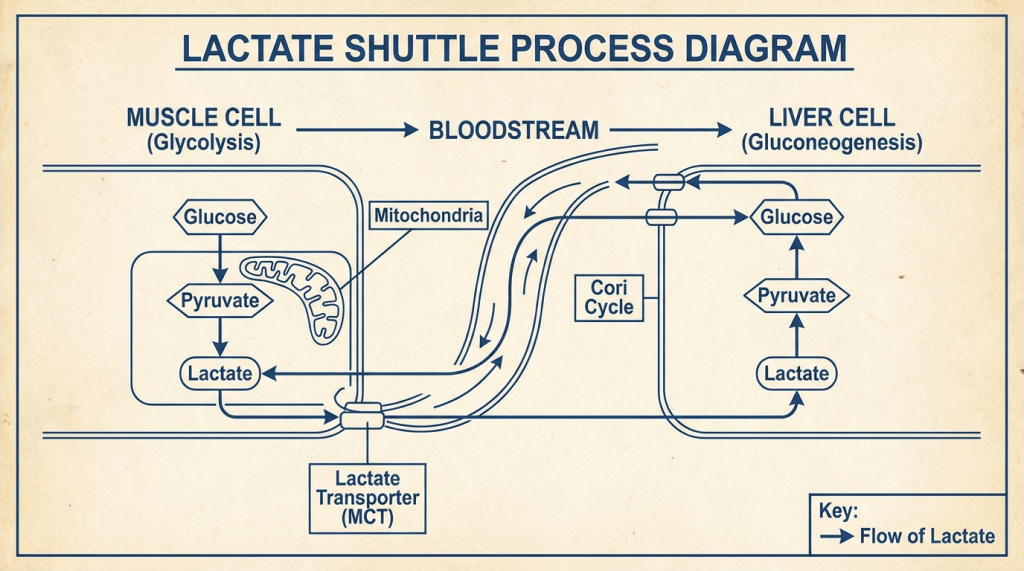
This is the big one, and it comes from a UC Berkeley physiologist named George Brooks who published a landmark paper in 1985 describing what he called the “lactate shuttle.” His argument, which has been extensively validated since, is that lactate functions as a mobile fuel source. Your body actively moves lactate from the muscles producing it to other tissues that can burn it for energy: other muscles, the liver, and especially the heart. Your heart loves lactate. During hard exercise, it becomes the heart’s preferred fuel source.
So the molecule you’ve been told to flush out of your body is actually one of the things keeping you going.
I remember the lecture where I learned this in my physiology master’s program and thinking “wait, then what have we been telling people?” The answer, unfortunately, is: the wrong thing, for about 40 years. (We’re still telling people the wrong thing, for the most part. Progress is slow.)
Okay, so what IS “lactate threshold”?
It’s still a real and useful concept, just not quite what most people picture. Your lactate threshold (or LT, or one of the dozen other names for it, which is a whole other article) is the exercise intensity at which lactate production starts to outpace clearance. Below it, your body handles the lactate just fine, shuttling it around and burning it. Above it, lactate accumulates in the blood because you’re producing it faster than you can use it.
But it’s a curve, not a cliff. There’s no moment where things suddenly break. And the curve is highly trainable. When you build a bigger aerobic engine, more mitochondria, better capillary networks, improved MCT transporters (the proteins that shuttle lactate between cells), you push the whole curve to the right. You can sustain harder efforts before accumulation overwhelms clearance. That’s a big part of what “getting fitter” actually means at the molecular level.
And soreness?
Lactate has absolutely nothing to do with delayed onset muscle soreness. Blood lactate returns to baseline within an hour or two of exercise. DOMS peaks 24 to 72 hours later and is driven by microstructural muscle damage and the inflammatory response that follows. These are completely separate processes on completely separate timelines. This one isn’t even a close call.
Why this matters for your training
Understanding lactate correctly doesn’t mean you need to overhaul your program, but it does reframe some decisions. You don’t need to “flush” lactate after hard efforts. Your body is already using it as fuel. Easy cool-down spins are fine for other reasons (I’m a big fan of gradually winding down rather than just stopping), but they’re not clearing a toxin. The lactate you produce during intervals is a signal and an energy source, not a poison. And when your coach says “build your aerobic base,” part of what that really means, at the cellular level, is train your body to be better at shuttling and oxidizing lactate.
The old story is simpler, which is why it survived so long. But the real story is more interesting, more accurate, and if you actually understand it, more useful.
Want the full molecular picture? Read the Deep Dive: The Lactate Shuttle: How Your Body Actually Uses Lactate During Exercise →
Have questions about how your training zones relate to lactate? Book a consultation with RVA Endurance PT.
 RVA Endurance PT
Leave a comment